

How To Set Words To Music
For the Jan installment of my SoundMakers residency, I want to write well-nigh setting words to music. The slice I wrote for SoundStreams posed some interesting text-setting challenges, given the fact that it'southward in Sometime French and every word echoes for 5–ten seconds after beingness sung. Text setting is an surface area where composers often miss the point, so I'm going to look at some of the key considerations involved, and then I'll describe how those play out in a piece like Longuement me sui tenus.
Likewise many composers treat text setting similar part making: an obligatory chore you have to exercise when yous're working with singers, just not an integral part of the compositional process. That's a huge lost opportunity.
Words are special, and people hear them differently from other elements in music. They need to be treated the same way you would treat rhythm or harmony or phrasing. Done right, text setting can infuse your music with complication and pregnant y'all wouldn't take gotten from sound solitary. (This is, after all, the only way to explain the appeal of most of Bob Dylan's oeuvre.) Done wrong, text setting distracts from the piece, makes your singers look awkward, and covers up the interesting $.25 in the music.
Intelligibility: is information technology actually that important?
I'm sure you've seen those lists of commonly misunderstood lyrics—Jimi Hendrix's "'Scuse me, while I buss the sky" heard as "'Scuse me, while I buss this guy" is one of the most famous examples. So my outset rule of text setting is, counterintuitively, that y'all can never guarantee that anybody will understand the words. The goal is non perfect communication, it is effective communication.
The traditional school of text setting tells you that comprehension is always Goal Number 1, simply our everyday experience with music tells us otherwise. Some people listen intently to the words, others don't actually notice them. Some songs are amend when you listen to the text (east.g. Tom Waits, "Tom Traubert's Blues"), others actually get worse if y'all pay as well much attending to what the lyricist wrote (eastward.g. Black Eyed Peas, "I Gotta Feeling").
Zip all that special about the music, but the lyrics are genius.
Go ahead and shake your bootie, simply don't listen too closely…
Consequently, I take a more relativistic arroyo to text setting. Sometimes you'll desire to put the music in service of the words, sometimes it'll be the opposite—but yous should decide consciously. Adding words is not like adding an oboe to your Pierrot ensemble: text fundamentally changes the nature of the experience and our relationship with the other musical materials—even though the way we listen to lyrics varies wildly from person to person.
All those caveats bated, notwithstanding, this doesn't mean you can merely ignore text-setting considerations. You volition still want to follow Text Setting 101 rules most of the time. In its nearly basic class, this ways you line up the stresses in the words and clauses with the stresses in the music. Notice how Hendrix does information technology: "'SCUSE me / / while i Osculation the SKY." Classic text setting: the important words are emphasized metrically on strong beats, in that location's a pause where the punctuation falls, the vocal rhythm more than or less matches the default speech rhythm, and the ensemble cuts out to allow the words be heard conspicuously.
Yet despite doing everything by the volume, people consistently hear this phrase wrong! Part of that is in the discussion option: buss this guy is a much more probable phrase than osculation the sky. But part of it is besides the fact that words in music are not wholly about communicating literal meaning. At that place's a give and take between the emotional or sensory aspects of music and the linguistic significant of the text. That's why important words and clauses tend to become repeated in music much more often than they would exist in speech (notice how the Da Capo aria has this functionality built into the form).
Music to stress textual pregnant
If y'all but ever set text in a traditional, word-stress mode, your music will be really ho-hum. Great text setting teeters on the intersection between intelligibility, musical significant, and textual meaning. It provides a function similar to musical consonance and noise, where the push button and pull of opposing forces makes the development interesting.
Sometimes, for example, you'll use musical elements to emphasize some deeper pregnant that sits below the words. The text may or may not be like shooting fish in a barrel to understand, but there will be something unusual about the setting that is chosen because of how it connects to the music, not because it parallels everyday spoken language.
1 of my favourite examples of this is from Xiu Xiu's 2022 album Angel Guts. The song "Cynthia's Unisex" features a relentless, driving synthesizer drone, pumping out a steady stream of noisy 16th notes throughout. Most of Jamie Stewart's singing on the runway is floating and arrhythmic, contrasting to the driving rhythm beneath information technology. Even so, at several points in the vocal, he breaks into a long, frantic stream of no no no no no no no no no no no synchronized precisely with the synth drone and declaimed in an unnaturally rapid style. (He besides does it in one case on aye.)
The effect is jarring. The outset fourth dimension I heard it, it sent shivers down my spine. If the goal were only to sing the word no, that could take been washed in countless other ways that preserve intelligibility and mirror natural spoken communication. However he purposefully chose an awkward text setting that sounds forced. Why? Considering it parallels the athwart synth part, making us acutely aware of its pervasiveness. It'south like someone all of a sudden pouring a bucket of cold water over your head: y'all can't help but reassess your relationship to what's going on around you. Musically, it also meshes beautifully with the ethos of the vocal, tying into the deeper paranoid quality of the lyrics. Information technology's a masterful case of a musical device used to emphasize textual pregnant.
Words to stress musical meaning
Sometimes, y'all'll likewise want to use words in service of a musical concept, even if it means fudging the textual meaning a niggling. You'll find tons of this in James Dark-brown's singing, peppered as information technology is with Hey!, Whoo!, Yeah!, Smokin'!, Striking me!, Git downwards! and countless other vocal placeholders. "Get Up/Sex activity Machine", "Hot Pants", "Common cold Sweat", "Papa Don't Take No Mess"—all smashing songs but not exactly pinnacles of poetic accomplishment.
Much of musical melisma as well falls into this category. I honey the Dingy Projectors' "Constabulary Story", a raw, delicate tale of constabulary brutality sung with an well-nigh bizarre level of melisma. When David Longstreth sings "They put me away" at the end of each poetry, he dwells on away, turning it into a long, flowing melisma that completely destroys the intelligibility of the give-and-take. Nosotros can guess the word from the context that precedes it, merely if nosotros jumped in correct there without context, we would have no idea what word he was singing. That'due south okay, because the indicate is not to make the word more clear, it's to drive the musical course, to create a sense of release before the next section.
Bang-up text setters are non agape of burial the lyrics when it suits the musical moment. Not all song music is about words, after all. If that weren't the instance, reading books of lyrics would be every bit popular every bit listening to music. Shifting the office of your text back and forth between its literal meaning and the musical meaning behind it is a fantastic mode to create richness and complexity. It also "dummyproofs" your piece, by making it highly-seasoned to both people who like to focus on lyrics and those who don't.
Flirting with Old French
With that context in place, I'chiliad ready to say a few words well-nigh Longuement. Beginning of all, the piece is in Old French, which nobody speaks anymore, so intelligibility is kind of a moot signal. However, I didn't want information technology to sound like I was ignoring intelligibility either. If the setting is awkward, information technology'll trip up the singers and make the piece cumbersome, fifty-fifty if nobody understands the words.
For the most part, therefore, I followed the Text Setting 101 rules outlined above. I highlighted words that are important to the meaning of the piece and ready them by stress. However, I also paid conscientious attention to words that resemble their modern French equivalents, which gave me another level of linguistic push button/pull to play with: words you can empathize vs. words you tin't. In the same way that a Northward American might not understand all of what the actors are proverb in a slang-filled British sitcom, Longuement lets the French-speaking brain puzzle over the juxtaposition of familiar and unfamiliar words.
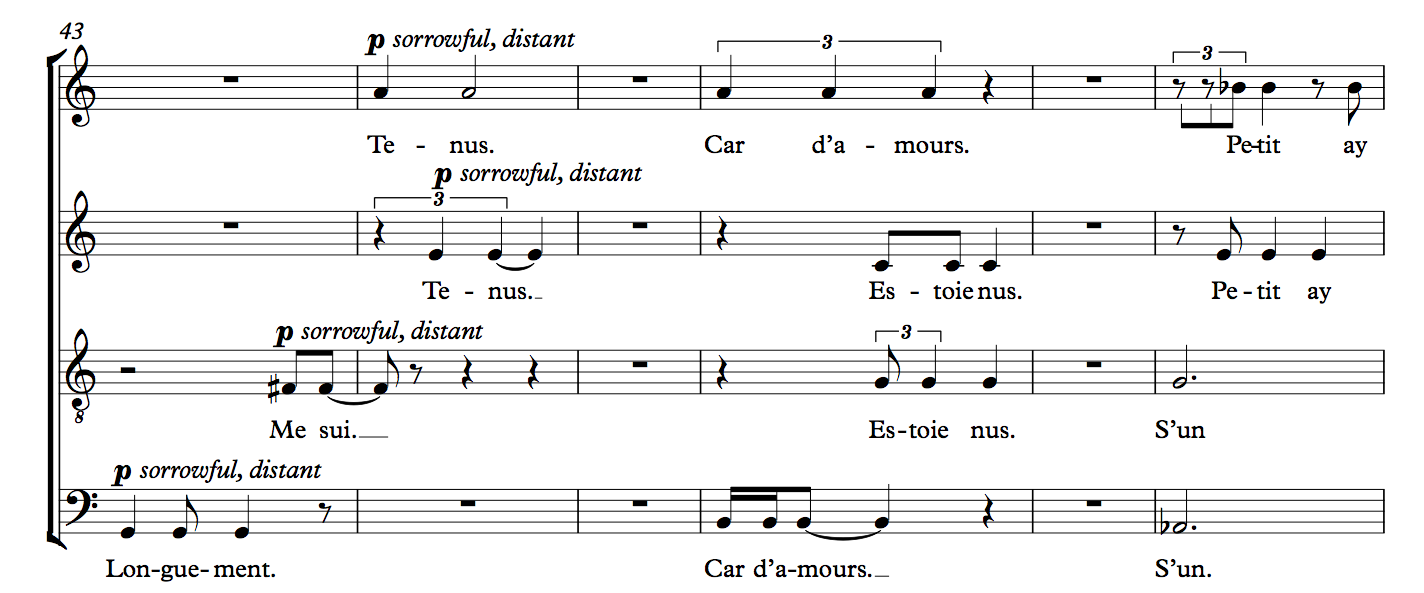
Case of tension between Old and Modern French words
In the example to a higher place, the Old French "Longuement me sui tenus" is not that dissimilar from the modern "Longuement je me suis retenu" (English: "For a long time, I've held myself back"). The missing je and the simple past tense might throw off modern French speakers, only it'due south decipherable. The apply of tenus instead of retenu is weird, since tenu(due south) in modern French is the past participle of to hold [in your hands], non to hold back. You lot tin can sort of feel what information technology means, but there's something off nigh it, and that creates a type of dissonance.
Similarly, "Car d'amours estoie nus" ("For of beloved I was bare") flirts betwixt sense and incomprehensibility. Motorcar d'amours is straightforward in modern French, if a bit poetic, and nus matches the modern nu, meaning naked. Y'all wouldn't say, "I was naked of dearest" in modern French or in English, but the sense of lacking is there, leading your thought process in the same direction as the English words bereft or bare. What trips you lot upward, though, is the verb form estoie, which sounds very different from the modern French j'étais. If y'all speak Castilian, yous might see the connection with the verb estar, but it's not obvious from a French perspective. So you lot're left to approximate blindly at the key verb in the sentence, again providing a tantalizing puzzle for the brain.
Sometimes it's just music
In that location were too times where I left the musical meaning override the textual meaning. Equally an overarching rule, music has to come beginning in this piece, since most people won't empathize the text. For the most function, the compromises between text and music worked themselves out elegantly, but one spot where I had to make a definite call was the forte climax described in my final mail service, shown once again below.
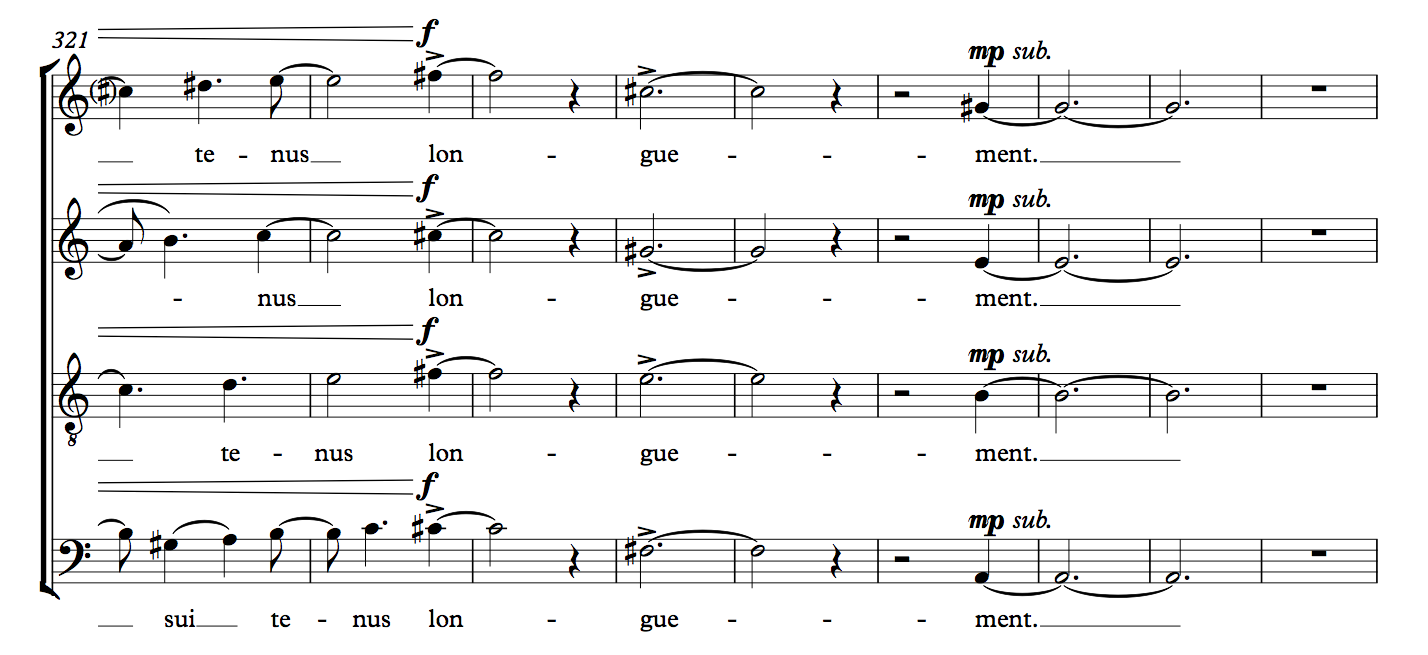
The /o/ in longuement is incommunicable to sing accurately in this annals
The section preceding this passage builds up a series of cacophonous runs that all end on the central discussion longuement. Each time, longuement gets a petty bit longer, until we accomplish the climax and it'southward stretched out over the forte loftier notes in each vocalism shown in a higher place. The problem, however, is that the vowel /o/ doesn't work well that loftier and loud, because of the beefcake of the mouth. When sung, the passage in a higher place will requite more of an open up /a/ audio.
After some mulling, I decided the musical outcome was more of import to preserve. The shape of the line and the feeling of the climax trumps the need to sympathise the word. Besides, by this indicate in the piece, we will have heard longuement many times, and the unabridged preceding passage is based on it. So despite the word being mispronounced, there's a expert run a risk people will hear the intended text. Sometimes, information technology's okay to pause the rules, as long as yous know why yous're doing it.
This mail service originally appeared on the SoundMakers composer-in-residence weblog.

How To Set Words To Music,
Source: https://aarongervais.com/blog/set-text-make-music-interesting/
Posted by: ramirezwasely.blogspot.com
0 Response to "How To Set Words To Music"
Post a Comment